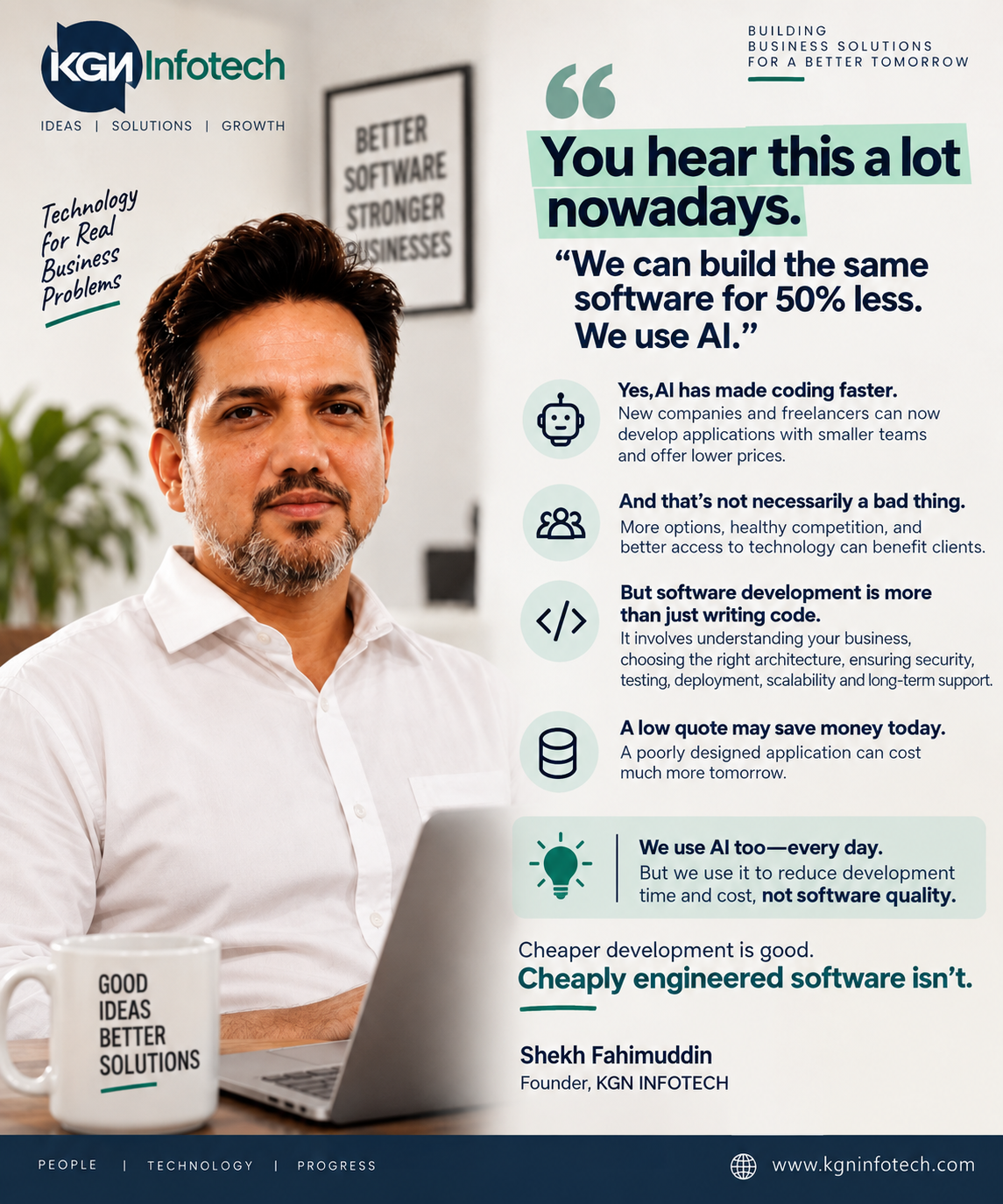
A conversation I increasingly hear in software development goes something like this:
"We can build the same application for half the price. We use AI."
At first, this sounds perfectly reasonable.
And to some extent, it is.
AI has dramatically changed the way software is developed. Developers can generate boilerplate code, build interfaces, write APIs, troubleshoot errors, create documentation and even generate tests much faster than before.
A freelancer or a new software company equipped with modern AI tools can often accomplish today what previously required a much larger development team.
As a result, development costs are coming down.
That is not necessarily a bad thing.
Competition is healthy. Businesses get more choices, smaller companies gain access to technology, and experienced development teams can become significantly more productive.
But there is another side to this change.
Software development was never just about writing code
When businesses compare two software quotations, they often compare features and price.
One company quotes X.
Another quotes 30-50% less.
Both proposals appear to contain the same modules.
So naturally, the question is:
Why should I pay more for the same software?
The problem is that two applications containing the same features can be engineered very differently.
Software development also involves decisions about architecture, database design, security, user permissions, performance, scalability, testing, backups, deployment, error handling, integrations, maintainability, and most importantly, understanding how the client's business actually works.
These decisions are rarely visible in a quotation.
But they become very visible when the application has been running for six months or two years.
AI can write code. Experience helps you decide what code should be written.
Suppose a client asks for a payment module.
Generating the payment integration itself is becoming increasingly easy.
But an experienced developer starts asking different questions.
What happens if the payment succeeds but the callback fails?
What if the user clicks the payment button twice?
How will reconciliation work?
Who can issue a refund?
What gets recorded in the audit log?
What happens if the payment gateway is temporarily unavailable?
The same applies throughout an application.
The difficult part of software engineering is often not writing the successful path.
It is anticipating everything that can happen around it.
And much of that understanding comes from experience, often from systems that failed, requirements that changed, and production problems that had to be solved.
We use AI too. Every day.
At KGN INFOTECH, AI has become part of our development workflow as well.
We use it for coding assistance, debugging, documentation, research, testing ideas, refactoring, and repetitive development tasks.
It helps us work faster.
And if technology allows us to reduce development time, that efficiency should ultimately benefit our clients too.
But there is an important distinction.
We use AI to multiply experience, not replace it.
The objective should not be:
"How cheaply can we generate this application?"
It should be:
"How can AI help us build a better application more efficiently?"
Those are two very different approaches.
The lowest quotation is not necessarily wrong
This is important.
A freelancer or a new software company offering a significantly lower price is not automatically delivering poor software.
They may have lower overheads.
They may be highly skilled.
They may use AI extremely effectively.
And they may genuinely be able to deliver an excellent solution for less.
So businesses should not automatically reject the lowest quotation.
Instead, ask better questions.
Ask about architecture.
Ask how your data will be secured.
Ask about backups.
Ask what happens when usage grows.
Ask who owns the source code.
Ask how changes will be handled six months later.
Ask what support looks like after deployment.
And ask who will take responsibility when something goes wrong in production.
Those answers often tell you more than the quotation itself.
AI is changing software pricing, and that is healthy
I believe AI will continue reducing the amount of manual effort required to develop software.
That means development will become faster.
Some applications will become considerably cheaper to build.
And development companies will have to provide more value for the same money.
That is good for customers and ultimately good for the software industry.
But businesses should remember one thing:
The cost of writing code is decreasing.
The value of good engineering is not.
A lower development cost is good.
Cheaply engineered software is not.
- Shekh Fahimuddin
Founder, KGN INFOTECH LLP